Poker Hands
Moreover, understanding Poker Hands goes beyond merely learning ranks—it includes using that knowledge for reading opponents’ plays, recognizing potential traps, and deciding when to be aggressive or conservative. A profound understanding opens up possibilities for mentorship, improving communication with other players, and even negotiation skills in social situations 33win game
Poker Hand Rankings in the Game
Building on the foundational knowledge of Poker Hands, an appreciation of their rankings offers players critical insights into the game’s structure. This category delves into how Poker Hands are ranked from highest to lowest, along with the underlying strategy that each hand implicates.
Poker as a game operates on the acknowledgment of strong and weak hands. By objectively evaluating your hand’s rank and juxtaposing it against your opponents, you can outline your winning path or identify when it would be wiser to retreat.
Rankings from highest to lowest
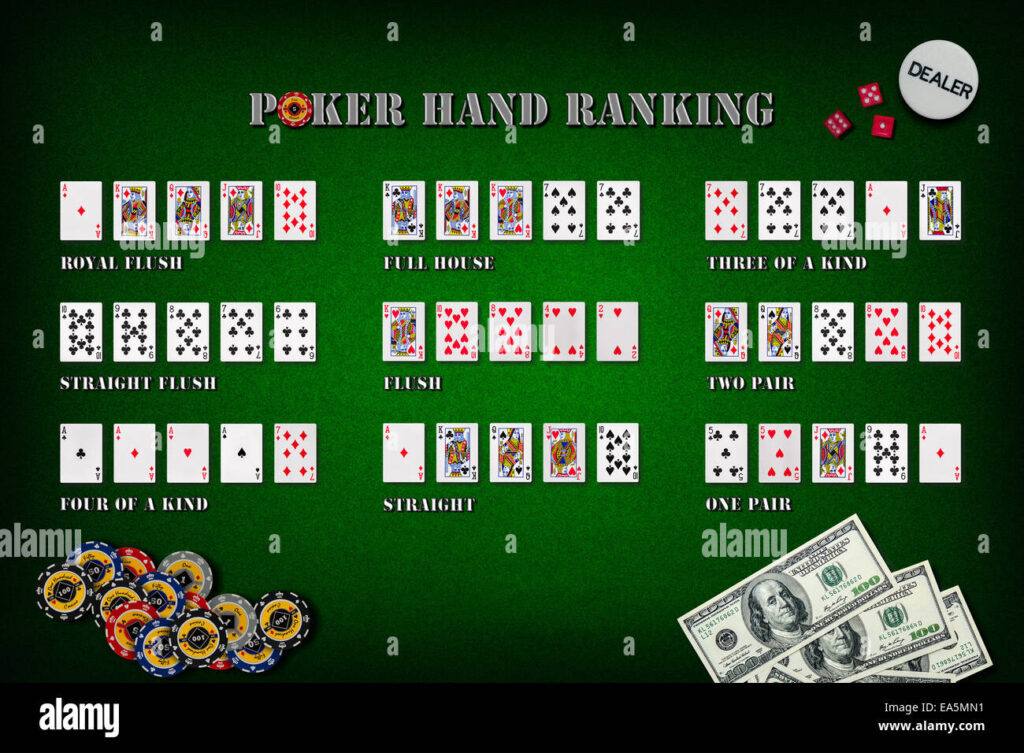
Understanding the established hierarchy of Poker Hands inherently shapes how one engages in the game. At the peak of this hierarchy is the royal flush, which is exclusively comprised of the Ace, King, Queen, Jack, and Ten, all in the same suit. Its rarity makes it the most coveted hand in poker. Coming down from that, we have the straight flush, highlighted by five consecutive cards of the same suit. Both hands represent monumental victories, but they also serve to elevate the stakes and tension at the table.
As we descend the ranking ladder, we encounter four of a kind, then a full house—which unites three of a kind with a pair—and subsequently moves on to flushes and straights, where flexibility borders uniqueness. This structured hierarchy means that as you gauge your situation during play, the strength of your hand must always be contextualized within the wider field of Poker Hands represented by others.
Awareness of how these rankings fluctuate in strength provides pivotal tactical advantages. For instance, if you hold a flush and detect high probability scenarios where opponents might harbor a full house, you need reconsideration on how aggressively you push your advantage.
The strategic meaning of each hand
From a strategic perspective, each Poker Hand embodies several implications related directly to your approach toward betting and staking your chips. A hand that falls into the “strong” category—like a three-of-a-kind or better—might embolden you to bet aggressively and logically bluff your way through the round. Conversely, weaker selections can mandate more conservative playstyles—folding when necessary or calling selectively.
Even at lower hand rankings, callbacks to fundamental poker strategy reveal where bluffing becomes pertinent. If an opponent plays aggressively on a board showing low ranks, it may be time to reassess your humble holding of a high card. Strategic layering involves understanding your standing against not just static hand rankings but dynamic player behavior. An intersection of quantitative analysis (ranking) balanced with qualitative insights (opponents’ play styles) dictates your unique strategy over time.
How to Use Poker Hands to Win
Mastering your understanding of how to effectively use Poker Hands can mean the difference between victory and defeat. Knowing when to bet or fold is crucially intertwined with acknowledging the circumstances surrounding your hand compositions and assessing risks associated with your opponents’ potential draws.
Not every hand necessitates or encourages aggressive play. In fact, certain situations warrant a more subdued strategy, particularly if you perceive danger in your opponents’ behaviors or table dynamics. Here, situational awareness evolves into a cornerstone principle for success.
When to bet and when to fold
One of the primary challenges faced by players revolves around the decision of whether to escalate stakes through betting or retract risk by folding. To navigate this, it is essential first to reassess the strength of your current hand relative to the game state. High-stakes hands like a straight flush may spur immediate exuberance in betting, while mediocre holdings might present logical inclinations to fold.
The broader game dynamics further complicate straightforward hand evaluation. Always consider factors such as player tendencies, your table position, previous betting patterns, and what hands opponents might be potentially holding.
Additionally, honing the skill of reading the table enhances your betting strategy. Observe aspects like stack sizes or reactions from players who seem disconnected from table norms. Such intel cultivates insights promoting an innate sense of optimal manners concerning your own actions in correlation with your hand strength.
Analyzing opponents based on their Poker Hands
An often-overlooked dimension of Poker strategy is less about the cards you hold and more focused on observing your opponents. An astute player is one who constantly evaluates the entire table, gauging others based on known Poker Hands.
Begin with identifying behaviors linked to the strength or weaknesses illustrated by your opponents’ poker bets. Are they aggressively raising with lower-end hands, indicative of either recklessness or confidence? Or perhaps they’re timidly checking on premium holdings out of fear? These decipherable tells allow you to adjust your strategy in real-time, actively engaging with the intricate dance of poker strategy throughout the session.